Poyet calls Liverpool mid-table team without Suarez

“Hey! Liverpool! Ye’re nothing without Suarez!”

Sunderland manager Gus Poyet has earned the wrath of Liverpool fans by suggesting the Reds would be a mid-table team without his fellow Uruguayan Luis Suarez.
Poyet was speaking to El Observador, a Uruguayan publication, and to be fair to the Sunderland manager he was probably just heaping praise on Suarez rather than trying to question Liverpool’s squad depth. However his decision to do so in the run-up to such an important game for his Sunderland side, embroiled in the battle to avoid relegation, was inadvisable at best.
Suarez has of course been in stellar form this season after returning from his 10 game suspension. Currently level with Robbie Fowler as top Liverpool goalscorer in a Premier League season on 28 goals, there’s every possibility he’ll make the record his own tonight.
However to imply that Liverpool are a one man team would be to do them a disservice. Take Suarez out of the equation, and the next highest goalscorer in the Premier League is his strike partner Daniel Sturridge. Captain Steven Gerrard is also having an excellent season, scoring two penalties at Old Trafford ten days ago to bring his tally for the campaign into double figures. Coutinho, Henderson, Sterling and Skrtel have all contributed goals for Brendan Rodgers’ side as they keep the pressure on Manchester City and Chelsea.
Sunderland go into tonight’s game in 18th place, three points behind Crystal Palace in 17th but with a marginally better goal difference and two games in hand. No win in their last 6, coupled with Liverpool’s perfect record in the same period, would suggest tonight is a write-off for Poyet’s team. It will be interesting to see whether he puts out a weakened side and focuses instead on Saturday’s game against fellow strugglers West Ham.
A win for Liverpool tonight would lift them to second in the table, two points above Manchester City albeit with two games more played. Both City and Chelsea have yet to come to Anfield, and those encounters in April may very well be crucial in deciding who lifts the Premier League title come May 11th.

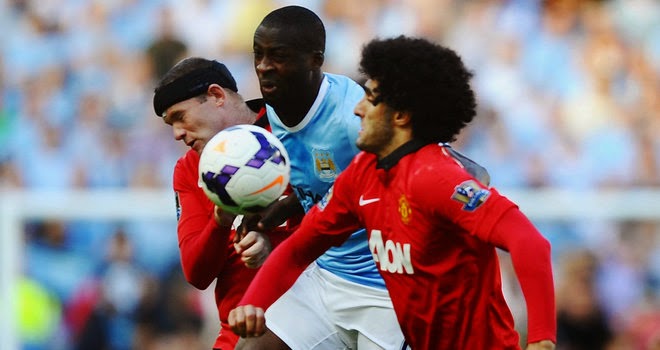
Manchester Derby: Toothless display from United as City march on

Dzeko gives City a very early lead
United tonight had the opportunity to have their say as to where the Premier League trophy spent it’s summer holidays. They capitulated with barely a whisper. A second consecutive 3-0 home defeat.
By the end of the game David Moyes was sat in the Old Trafford dug-out with a look on his face that is all too familiar to United fans this season. Bewilderment.
No sooner had the game began and City had the ball in the back of the net. 45 seconds was all it took for United’s positivity, garnered from two wins on the trot, to dissipate. Rafael did well to block Silva’s initial attempt but the ball eventually found its way to Nasri. His shot cannoned off the upright into the path of Dzeko who was left with the easiest of tasks.
City had the game by the throat and you feared that United would capitulate in the manner of Arsenal at the weekend. Silva was a constant menace, popping up everywhere in the final third. In the midfield Yaya Toure was controlling the tempo without breaking a sweat. Ominously for United, Fellaini, the man best equipped to deal with Toure’s physicality, was brushed off the ball by the big Ivorian easily in the 7th minute.
Moyes looked furious on the touchline. Tom Cleverley was moved to the right wing from a central berth with Mata heading in the opposite direction. Antonio Valencia was stripped off and ready for action with a mere ten minutes gone and it looked like Cleverley was going to be the one to make way. He got a reprieve and showed some promise as the first half developed, linking well at times with Rafael down the line.
City’s movement off the ball however was just too much for United. Nasri, Navas and Silva flitted about, occupying United’s defence while their full-backs made inroads down the sides. Zabaleta in particular was getting the better of Patrice Evra, but the Argentinian was subdued somewhat after shipping two nasty challenges within 15 minutes of each other. Welbeck took him out with a sliding tackle after quarter of an hour, and Fellaini was lucky to stay on the pitch following an elbow to the full-back’s face with half an hour gone. Both United players saw yellow.
United gained a foothold in the game in the last 15 minutes of the first half, but couldn’t make any meaningful progress behind the City defence. If Moyes’ plan A is to get the ball out wide and cross it early, then so be it. If that’s the case however, it’s something that needs more work at the training ground. Aside from Wayne Rooney, who should be in the box and benefiting from decent deliveries, not one Manchester United player this evening looked capable of threatening the City defence with a cross. Rafael and Evra over-hit the majority of their efforts, Mata often hit the first man, and substitute Antonio Valencia rarely threatened the byline, having lost much of his pace at this stage of his career.
Pace. That’s at the heart of United’s problems this season. They have no-one with the searing pace of a Ronaldo who can turn defence into attack in seconds. When they are under the cosh, there’s no outlet with which to relieve the pressure. The ball may make its way into the midfield, but any build up play is laboured and clunky. While both have other attributes, neither Carrick nor Fellaini seem capable of imposing themselves on a game the way Yaya Toure does for Manchester City. A central midfielder (or two) of that ilk is desperately needed in the summer. Parachuting Rooney, their biggest goal threat, into the midfield is not a viable long-term solution.
Manchester City’s second goal highlighted United’s shortcomings in defence too. City were dominating without creating much in the early stages of the second half. However in the 52nd minute they had a corner and Fernandinho flashed a header over following a flick on from Kompany. Fellaini had failed to follow the run of his compatriot. United had been warned. Two minutes later it was Rio Ferdinand who lost Edin Dzeko at another corner, and the Bosnian volleyed in from close range.
The second goal effectively ended the game as a contest. Welbeck had two half chances either side of the 70th minute, but it was comfortable for City. Jesus Navas made way for Javi Garcia, who sat alongside Fernandinho allowing Yaya Toure to roam further forward. It was the Ivorian who delivered the final insult when a cross from sub James Milner deflected into his path and he finished coolly down to De Gea’s right.

The talk tomorrow will focus on Manchester United’s toothless display, but City’s quality cannot be overlooked. They march on with the Premier League title still theirs for the losing.  United will be hoping for a pick me up when they welcome Aston Villa to Old Trafford on Saturday. That’s because a week from today they’re in Champions League quarter final action. Against an irrepressible Bayern Munich.

Manchester Derby: United hoping to derail City’s title ambitions

😌

City ran out 4-1 winners in September’s reverse fixture

Sky Sports may have raised a few eyebrows when they pronounced tonight’s Manchester derby as the “Race for the Title”, but regardless of Manchester United’s position in the table, they can still have a say in the destination of the trophy come May.
Tonight’s game is their final chance to do so however, as City are the last team they encounter this season still in the running. Manchester City could afford to lose tonight, as winning the rest of their games would most likely put them one point ahead of Liverpool and level on points with Chelsea with a superior goal difference come the 11th of May. However, with crucial games coming up against Arsenal and Liverpool, they would be leaving themselves with a mountain to climb should they capitulate at Old Trafford.
It says something about the shift in power in Manchester that United go into tonight’s game on home soil as underdogs. That’s something that would have been unthinkable during the Ferguson era. Such has been David Moyes’ maiden season in charge however, that home advantage hasn’t guaranteed one point, let alone three. West Brom, Newcastle, Spurs and Liverpool have all left Old Trafford with maximum points this season.
It seems that Moyes’ struggles to make the best out of the less than stellar squad bequeathed him by Ferguson has been met with a certain amount of Schadenfreude from opposing fans and the media. Where other manager’s travails have slipped under the radar somewhat, the focus on Moyes has been intense and unrelenting. While this may be unfair in some respects, some blame has to attributed to Manchester United’s transfer dealings, or lack of same, last summer. With a clear need to strengthen in midfield and at the back, United’s efforts in the summer ultimately amounted to the capture of Marouane Fellaini on the final day of the transfer window.
In contrast, Manchester City, themselves under new stewardship with the introduction of Manuel Pellegrini, identified their targets early and had time to integrate them into the squad before the start of the Premier League season. Fernandinho and Alvaro Negredo in particular have come in and strengthened the squad. When Manchester’s new managers went to battle for the first time at the Etihad in September, the home side ran out 4-1 victors. The tone for the season had been set.
However, while a Capital One Cup victory and possible Premier League success constitutes an impressive season, Pellegrini’s belief that his side could attain an unprecedented quadruple was misplaced. Defeat to Barcelona in the Champions League, after a second consecutive defeat at the hands of Wigan in the FA Cup, left that dream in tatters. The only English teams left in the Champions League are title rivals Chelsea and who else? Manchester United.
And so back to tonight’s game. United manager Moyes has kept his own counsel this week regarding the availability of his centre halves. With Michael Carrick having to deputise at the back in Saturday’s 2-0 win at West Ham, United fans will be hoping that at least one of Jonny Evans, Chris Smalling and Rio Ferdinand will be fit to face Kompany and co.
Shinji Kagawa and Juan Mata started at the weekend, with the Japanese international occupying the number 10 role apparently coveted by Mata. Moyes has stated that the Spanish playmaker is happy to occupy any position for the side. With City usually deploying full backs who like to get forward however, perhaps the manager may move Mata to a more central attacking role in order to facilitate a more defensive minded winger.
With Robin Van Persie unavailable yet again due to injury, United will very much depend on Wayne Rooney for goals tonight. Having found the net five times in his last five appearances against City, the £300k a week striker should be a key concern for Pellegrini. Two goals at the weekend will have boosted his confidence and City should aim to keep him, above all others, under wraps.
With Sergio Aguero out injured, and Alvaro Negredo in a poor run of form, it may be up to free-scoring midfielder Yaya Toure to inflict damage on United tonight. Fresh from a hat-trick against Fulham at the weekend, the Ivorian international will be City’s key player. While United fans may flinch at the idea of adapting tactics to stop other teams rather than just playing their own style of football, it is imperative that Moyes’ midfield tonight is set up right. Liverpool’s 3-0 victory 9 days ago at Old Trafford is a case in point. Jordan Henderson was allowed too much space and was involved in much of his side’s good play. With all due respect to Henderson, Toure is an infinitely more accomplished player at this point in time. If he is allowed the same space as the Liverpool midfielder then United will surely miss their chance to dictate where this year’s Premier League title ends up.

El Clasico: Messi hat-trick re-ignites Barca title challenge

Messi the difference in Bernabeu encounter

The latest instalment of El Clasico was preceded with a minute’s silence for Adolfo Suarez, the Prime Minister who united Spain after the reign of General Franco. Once the formalities were over, the only thing uniting Real Madrid and Barcelona was their desire to strike a blow to the other’s title hopes.
This game began at the pace we’ve come to expect in meeting of these two sides. Neymar had the first shot in anger in the third minute, and following a half-hearted Ronaldo penalty appeal, Iniesta drew first blood for Barcelona. A well-timed ball from Messi found the Spanish midfielder in plenty of space and he blasted a left footed shot across Diego Lopez and in off the woodwork.
That goal provoked Madrid and they responded swiftly. While all talk before the match was about Ronaldo and Messi, Bale and Neymar, it was Angel Di Maria who was running the show. He teed up Benzema in the 12th minute but the Frenchman squandered the opportunity, blasting over from close range. A few minutes later however the centre forward made no such mistake. Di Maria the provider again, Benzema rose highest to power a header past a despairing Valdes. The keeper got a hand to it, but it served only to place the ball in the top corner.
Di Maria and Madrid had their tails up, and three minutes later they took the lead. Di Maria was giving Dani Alves a torrid time down the left, and it was his cross again that found Benzema on the edge of the six yard box. A good first touch was followed by a smart volley with his right foot. The Barcelona players looked stricken as Ancelotti lost his usual composure celebrating on the sidelines.
With the combination of Di Maria and Benzema proving so effective, Barcelona would have been well advised to shackle them. The problem with that being that leaves space for messrs Bale and Ronaldo. So it was no surprise when Di Maria once more found space on the left flank to put in a cross. The ball eventually found its way to Benzema who shifted it onto his left and aimed for the bottom corner. Only a last-ditch block on the line from Gerard Pique prevented the French striker from completing a perfect hatrick.
It was all Madrid for large periods of the first half. When in possession, Barcelona faced a white wall near impossible to break down. Five minutes before half time however, Messi found a way through. His pass to Neymar inside the box deflected back into his path and he made no mistake, finishing low to Diego Lopez’ left. As Messi celebrated becoming the all time top scorer in El Clasico (19), Pepe and Fabregas rubbed noses and proceeded to fall to the floor. Both were awarded yellow cards for their efforts. There was still just time for Benzema to flash another header wide before the teams trudged down the tunnel. The 400 million people watching had time to draw their collective breath.
The second half didn’t spark to life until the 53rd minute. A jinking run from Ronaldo was ended abruptly with a trip from Dani Alves just outside the box. Incredibly however, the referee Undiano Mallenco pointed to the spot, despite the protests from the Barcelona players. Unconcerned with the Barca players’ feelings, Ronaldo dispatched the penalty to give Madrid a one goal lead that was to last just ten minutes.
As Ronaldo had scored the penalty, it was Messi’s turn to influence the game once more. His slide-rule pass to Neymar was inch perfect and the Brazilian went down in the box following minimal contact from Sergio Ramos. The Spanish centre-half was duly shown the 19th red card of his career. It was his third in an El Clasico, and the 13th shown in the past 14 meetings between these two sides. Messi made no mistake with the spot-kick.
Madrid coach Carlo Ancelotti sacrificed Benzema for compatriot Rafael Varane as he looked to protect the draw which would leave his side four points ahead of their bitter rivals. Zinedine Zidane was on hand to console Benzema as he came off without attaining his hat-trick.
Gerard Martino also made a change, taking off a disappointing Neymar and replacing him with Pedro. Calls had been made for Pedro’s inclusion from the start, given Neymar’s recent run of poor form as opposed to the Spaniard’s 14 goals and 8 assists this season.
The game died down again following Messi’s penalty, with both sides fighting hard for possession in the middle of the park but failing to make any significant breakthroughs. Dani Alves struck the base of the left post in the 73rd minute but the rebound failed to find any players in blue and red. Martino brought on Alexis Sanchez another player who had cause to be disappointed not to start the game. The Chilean had 17 goals and 7 assists before this weekend. Cesc Fabregas made way after an underwhelming performance.
It was neither Sanchez nor Pedro who were to make the vital contribution to the game however. Andres Iniesta, who had been lively all evening, found himself near the left by-line being marked by Carvajo and Alonso. As he tried to drift through the non-existent space between them, he found contact and went down. The referee pointed to the spot once more amidst howls of protests from the Bernabeu faithful. Messi blasted the penalty high into the roof of the net to secure his 26th career hat-trick. He scored his first against the same opponents way back in 2007.
The game ended scrappily as Madrid struggled to reclaim the ball from their opponents. Martino may have introduced a Plan B to this Barcelona side’s armoury, with crosses and diagonal balls not uncommon in games, yet this was all Plan A. Patient build up play, supporting the player on the ball. Alonso, Ronaldo and Modric received yellow cards for kicking the shadows they chased in the closing stages.
85,454 people in the Bernabeu to witness the latest in a long line of classic El Clasicos. When the final whistle blew, all that could be heard was the jubilant singing of the travelling Barcelona supporters.
Celebrating too will be Atletico Madrid. This result leaves them top of La Liga following their 2-0 victory away to Real Betis earlier this evening. Level on points with their bitter city rivals, they have a better head to head record. Barcelona’s victory brings them to within a point of the Madrid sides. Real Madrid must finish clear points ahead of both sides to claim the championship.
The last La Liga El Clasico of the season is by no means the last time these two magnificent sides will meet. They lock horns once more in the Copa Del Rey final on April 16th, and there is still the possibility that they will meet in the semi-finals or final of the Champions League. After matches like this one, we can only hope.

El Clasico: Messi v Ronaldo not the only show in town

An intriguing encounter in store tonight
El Clasico. There’s no more intriguing game in the football calendar. Leaving aside the political context, Real Madrid and Barcelona is never a boring spectacle. For the past few years it has been the Ronaldo and Messi show. That duel still takes centre stage, but this season there’s a wonderful supporting act in Bale and Neymar.
In the last El Clasico at the Camp Nou in October, the home side ran out 2-1 winners following goals from Neymar and Sanchez. That goal helped endear Neymar to the Barcelona support following his high profile summer move from Santos. Unusually however, the Brazilian’s transfer has come under even more scrutiny in the interim. It has emerged that the Catalan side paid far more than originally estimated to secure his services.
Off the field problems aside, Neymar has struggled for consistency when playing for the Blaugrana. His best spell coincided with Lionel Messi’s absence due to injury. Since Messi’s return this year, Neymar has found it difficult to be as effective. Could it be that Neymar needs to be the main man in attack in order to reach his full potential? Can he and Messi form a long-term beneficial partnership up front? Games against teams in the lower half of La Liga can only tell us so much. Real Madrid in the Bernabeu  will give a real indicator as to how the two South American stars can play together.
Messi himself has cut a frustrated figure at times this season. Gerardo Martino’s time at the helm has seen a slight shift away from the tiki taka football cultivated to devastating effect under Pep Guardiola and Tito Vilanova.  This season has seen an emphasis in some games on diagonal balls and crosses, as opposed to patient build up play with the ball and urgent pressing without it. Martino is clearly trying to formulate a Plan B that Barcelona can switch to when opponents are difficult to break down. However these tactics need a genuine number 9 who can hold up the ball and get on the end of crosses. Messi is many many things, but an old style centre forward he ain’t. Noises from the Camp Nou suggest that Martino will move on in the summer, most likely to take over the Argentina national side. If he does, expect to see an advocate of Tiki Taka hired in his place. Messi is the one player who Barcelona don’t want to upset. He was the star of Barca’s 7 goal dismantling of Osasuna last week and will likely need to reproduce those goal scoring exploits at the Bernabeu. 
Since defeat at the hands of their bitter rivals in October, Real Madrid haven’t lost a game. This extra-ordinary run has been facilitated by a cohesive unit who are as potent in attack as they are  solid in defence. Ronaldo has been in his usual superlative form, and has been adequately supported by the player who usurped him as the most expensive footballer on the planet, Gareth Bale. Bale played in the last El Clasico while still not clearly fully fit (he didn’t have a pre-season), but since then he has been in flying form, weighing in with 14 goals and 17 assists as Madrid marched to the top of La Liga and into the Champions League quarter finals. His former team-mate at Spurs, Luka Modric, has been imperious in the midfield, with short odds on him being voted player of the season in La Liga.
Also in good form has been Karim Benzema, with Zinedine Zidane’s move from upstairs to the coaching team being credited for improving the French striker’s performances. The number 9 is a doubt for tonight, and Jese Rodriguez is certainly out. If Benzema doesn’t recover in time, Arsenal target Alvaro Morata may see game time. An extremely talented youngster, he has yet to  prove his worth to a dubious Carlo Ancelotti.

With Barcelona’s difficulties at the back (set to be compounded at the end of the season with Carlos Puyol’s retirement) it is difficult to see past Real Madrid for tonight’s game. However, if Messi and Neymar manage to combine to good effect, there’s always a chance Barcelona could sneak a result. A win for Real is a disaster both for Barcelona and neutral observers, as it would leave the Catalans 7 points adrift entering the home stretch of the season. A draw would suit Atletico Madrid as well as anyone, as they travel to Real Betis beforehand and could be level with their city rivals at the summit before El Clasico brings the footballing world to a standstill. 

Ireland clinch Six Nations in Paris

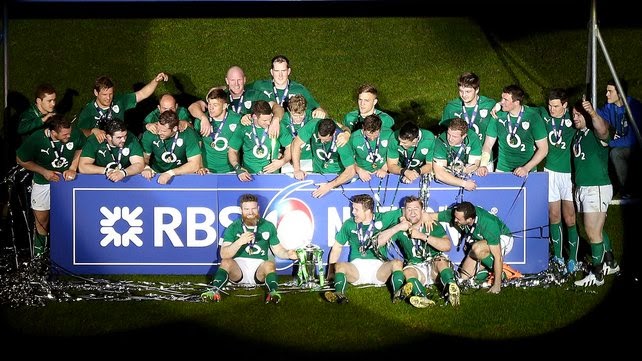
2014 Six Nations Champions 

There would have been no shame in defeat, and yet no solace either. All week the question was which France would turn up; the clueless team of individuals or a ruthless try-scoring operation. The truth was somewhere in between. Individual brilliance with just enough cohesion to make Ireland sweat to the last.
Ireland gave themselves headaches at times, particularly in the first half. The kicking out of hand, which Ronan O’Gara stressed beforehand would be so important, was marginally off. In a game to decide the outcome of the Six Nations, small margins can be crucial.
Two tries and two awful kicks at goal. If it wasn’t for the elbow to the head from the 18 stone Mathieu Bastereaud, Jonathon Sexton would remember this game for a long time. Thankfully he was able to join in the post-match celebrations even after being stretchered off in the 65th minute. Irish fans chewed nails as his replacement Ian Madigan took to the field. Preferred on the bench to Paddy Jackson today, this was his first appearance in the 2014 Six Nations. 
With Jordi Murphy the only sub not to take to the field of play, Ireland were left with a good deal of inexperienced players to close out the game. While the scrum lost some of its ballast after the withdrawal of Ross and Healy, in open play Ireland were to a man committed and disciplined until the end. It’s expected of the old hands. It’s a joy to see it from the next generation.
The French, as is their wont, woke up from their Six Nations slumber today. Switched on from the start, they took a 6-0 lead before two quickfire tries from Sexton and Trimble put Ireland ahead. The home side’s response was swift and sublime. A crossfield kick from Tales was parried beautifully by Huget back for Dulin to dot down. The second of Sexton’s missed kicks ensured France went in one point to the good at half time.
The second half was as tense as they come, with neither side letting up in the intensity. Ireland struck first, with a break from Trimble finished off by Sexton with assistance from the O-Apostrophes.
These are the players by which the golden generation of Irish rugby is defined. Captain Paul O’Connell was immense today. It’s a mark of the man that when you see blood on his face during battle you’re never quite sure if it’s his. He threw himself into tackles with the usual vigour, and made laughable last year’s notions that he was a spent force.
And then there’s O’Driscoll.  He was involved in much that was good about Ireland today. While there’s perhaps an argument that Andrew Trimble deserved the man of the match award today for replicating his Ulster form, it was only going to one person.If anyone thought he would go quietly into the international rugby retirement home they were mistaken. And if BOD himself thought he could waltz quietly into the Parisian night at full-time, he too was wrong. A French interviewer attempted to cajole the outside centre into “one more year.” O’Driscoll smiled and shook his head. As retirement parties go, this one takes some beating.
O’Driscoll held it together during his interview with RTE until he brought up the influence of Joe Schmidt. The respect he has for the former Leinster coach was clear to see. It’s a mutual respect, as evidenced by the Ireland head coach’s assertion that “we’ll get someone to fill (O’Driscoll’s) boots, but their feet might be a bit smaller.” Indeed.
Late on there was a sense that France might spoil the party. A try from hooker Szarzewski  had Irish fans covering their eyes. However a horrible penalty miss followed by a late forward pass with men over on the right wing denied Les Bleus a win that would have handed England the Six Nations championship.
In Rome, tears surely trickled down tuxedos as the English squad watched on helpless. Like Ireland in 2007, hammering Italy on the final day just wasn’t enough. Theirs is a good team with a capable manager. The World Cup next year is on their territory and they will not capitulate easily.
Ireland under Schmidt have raised the bar high for themselves. The New Zealand game showed they could compete with the best. Today showed they can concentrate for a full 80 minutes plus. There must be no let up between now and the World Cup. Those who have earned their first caps must muster such intensity every time they pull on the green jersey. The hardened veterans must hold on to the hunger for more silverware. For tonight though, it’s time to celebrate. Gordon Darcy’s beard will soon be no more.
A championship clinched in Saint Denis on St Patrick’s weekend. It doesn’t get much better than that.

Can Ireland make it to Euro 2016?

Ireland have been handed a difficult but not impossible task after being drawn in Qualification Group D for Euro 2016.
With Germany top seeds in the group, Ireland have to face Joachim Loew’s side for the second qualification campaign in a row. Ranked second in the world, the Germans inflicted a 9-1 aggregate defeat on the Boys in Green on their march to Brazil 2014.
Theoretically fighting with Ireland for the remaining automatic qualification spot and play-off place are Scotland and Poland.
Propping up the table, (barring disaster for the teams mentioned above) should be Georgia and Gibraltar. Gibraltar only attained international status in May of last year. Georgia, in its 20 years of playing competitive international football, has finished 6th in qualification groups more often than not. Ireland put four past them last June in an Aviva friendly.
With the talent at Jogi Loew’s disposal, it is difficult to see how Germany could drop points, let alone fail to finish top of the group. A team with a mix of youth and experience, and a spine consisting of players from Bayern Munich’s treble winning side and Borussia Dortmund, should take this group at a canter. It is difficult to select the key player for the Germans, because as soon as the focus shifts to one Wunderkind another one overtakes him.

Bayern Munich star Toni Kroos

Mercurial talents such as Marco Reus and Mezut Ozil offer potency in attack, while a midfield consisting of Toni Kroos, Mario Gotze Sami Khedira and Phillip Lahm (if played there) won’t be overrun too often. At the back, Mats Hummels is an extremely intelligent centre-half alongside a resurgent Per Mertesacker. If they have shown any weakness in the recent past  it was when they switched off at 4-0 up against Sweden in the last qualification campaign and ended up shipping 4 goals and two points in the process. While there is a possibility of them scoring four against Ireland, Scotland or Poland, it is unlikely they will capitulate and concede four again.
Of the teams challenging for second and third in the group, on paper Poland would seem to have the advantage. Their star striker Robert Lewandowski plays Champions League football with Borussia Dortmund and will move to the all-conquering Bayern Munich in the summer. Polish captain Jacub Blaszczykowski  also plies his trade at Dortmund. However Poland have never beaten Germany in 17 attempts. Most recently they played out a two-all draw in September 2011. Outside of their Champions League stars, their line-up is solid if not spectacular. They finished 4th in the qualifying campaign for this year’s World Cup after a promising start.

Lewandowski struggles to spell his captain’s name

Scotland under Gordon Strachan are slowly growing in confidence. Early losses during his reign put paid to any qualification hopes for Brazil, but wins in the meantime against Croatia and Macedonia indicate the former Celtic manager has bedded in well. The clashes against another former Celtic boss in Martin O’Neill will go a long way to determine the final positions of both Ireland and Scotland in the table. You can bet either O’Neill or his assistant Roy Keane will watch and rewatch the video of Scotland’s friendly trip to Poland next Wednesday.
And what of the dark horsemeat of the group, Gibraltar? They have a fairly decent record having drawn with Slovakia in their first ever UEFA recognised game last November. It ended nil-all so it’s difficult to make out where their goals will come from as yet. Maybe former Derby County, Sunderland and Stoke central defender Danny Higginbotham? Though he has said he will retire soon so may not even be in the squad come the beginning of the qualifying campaign. Like all teams who Ireland play, they should be treated respect (Cyprus and San Marino spring to mind), but 6 points are an absolute necessity for O’Neill’s men.

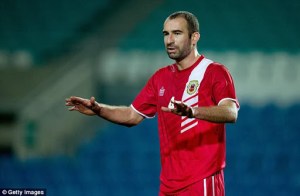
Danny Higginbotham. Gibraltar’s danger man?

And what of Ireland themselves? Can we compete with Poland and Scotland? Irish fans would hope so, while Roy Keane would probably question why we can’t take six points off of Germany as well. This attitude is sure to serve the Boys in Green better than Trappatoni’s thinking that our team wasn’t good enough to play football against the big boys. With four potential Irish starters at a well managed Everton under Roberto Martinez, the hope is that there is a strong core in the immediate and long-term future of the Ireland team. The question of where Ireland’s goals will come from is pertinent, but hopefully Paul Green will chip in with a few.

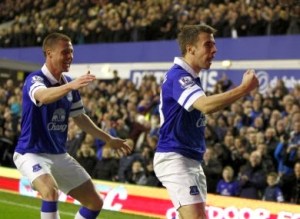
Coleman and McCarthy will be crucial to Ireland’s chances

Ireland finish the qualifying campaign with games at home to Germany and away to Poland. Whatever about the Germany game, the Poland tie could be crucial in deciding the fate of both teams involved and Scotland. It’s the same day Ireland take on France in the Rugby World Cup. Some days Ireland’s sports stars take on the world and win. 21st of March 2009. Ireland beat Wales in Cardiff to claim their first Grand Slam since 1948. Later that night in the O2 Arena, Bernard Dunne knocks Ricardo Cordoba out in the 11th round to claim the WBA Super-Bantamweight world championship. A glorious day. All of Ireland rejoiced. Perhaps the 11th of October 2015 will be such a day.

Does leaving Ireland make you more Irish?

A year ago today I stood in the arrivals hall of Dublin airport, impatiently checking the blinking board to see whether my sister’s flight  had landed. When confirmation finally came, I turned my attention towards the sliding doors.
It was simple enough to separate the returning emigrants from the casual travellers. The smiles and sobs that accompanied their entrance through the doors gave it away. Some waiting family and friends would scream in delight and run towards their loved ones. Others would stand motionless with tears streaming down their faces, hesitant as though they weren’t sure this moment  -this wonderful moment they had dreamed of since they had said their goodbyes years or months previous – was actually happening.

Amanda arrives home
It was a lovely few minutes. Then my sister arrived. As she chattered about the time of her life she had had living in Potsdam on Erasmus (the second time of her life that year after living in Southern Argentina for 5 months), I pondered on what defines an emigrant. I didn’t categorise my sister as an emigrant, because she had left Ireland as part of her university degree.
Three years previous I returned home after spending a few months on Erasmus in Prague. I certainly wasn’t a returning emigrant then either, though it was fun to pretend while gallavanting around the Czech Republic that I was part of the true diaspora, tragically cast out of my homeland due to a lack of jobs and hope. In reality I studied some poetry, drank cheap beer, wrote some essays and came home in time for the Christmas dinner.
Joseph O’Connor – one of Ireland’s most prominent writers- wrote a passage in an article about Irishness which I first read a few years back.
                “Being Irish abroad is a fine thing for a writer to be. It means you probably won’t get shot                   in the event of an aeroplane hijack, and it certainly helps you understand just how very                      Irish  you are. Indeed it sometimes seems to me that you almost have to get out of Ireland to                be Irish at all, in some important sense, that those who stay turn out to be the real exiles,              whereas those who go are the natives.”
By O’Connor’s reckoning, up to March of this year I was an exile in my own country. Not that it stopped me writing about the experiences of others abroad. So many of my friends had left Ireland for work that it was a source of endless fascination to me how they coped with the changes in environment, weather, culture. I wrote my MA thesis on perceptions of Irish emigrants.  Emigration was my never-ending source of material and I hadn’t even stepped on an aeroplane.
The night before I left for Korea, amid all the last minute rushing, O’Connor’s words popped into my head. I fished out the book and took a picture of the passage to bring with me. My reckoning was that if I hit a rough patch of homesickness in the Far East I could use the words as a soothing balm. They’d be there to tell me that now I was really Irish.
In reality, ten months into my time in Korea and I’ve had little use for the words. There have been moments of homesickness of course, and moments of doubt. That fear of missing out you have on nights when all your friends are somewhere and you opt to stay at home? Triple it and you’ll be some way towards realising the terror that can strike when you see friends at home getting their foot on their chosen career ladder. You’re happy for them, but there are times when you wish it was you who had the guts to wait it out in Ireland.
Nevertheless, these 10 months have been a joy. There’s a lot to recommend about Korea. It’s not a harsh lifestyle, the cities are vibrant, the work is plentiful and the money decent. The amount of ex-pats over here might surprise you. Even in Gwangju, a relatively small city by Korean standards, there is a sizeable foreigner community. Ubiquitous as we are, naturally many of the community are Irish.
There were two Irish stalls at a recent international day in the city, there’s an Irish-run bar, and one of the biggest nights of the busy summer months was a traditional music session held there. Sometimes there are moments when it’s difficult to comprehend just how far we are from home. When O’Connor wrote that article, a long time before I read it in an anthology, Ireland and Irish emigrants were different. If you left Ireland, save for a scribbled letters or long distance phonecalls, that was the end of you. You couldn’t really keep in touch with home and home couldn’t really keep in touch with you.

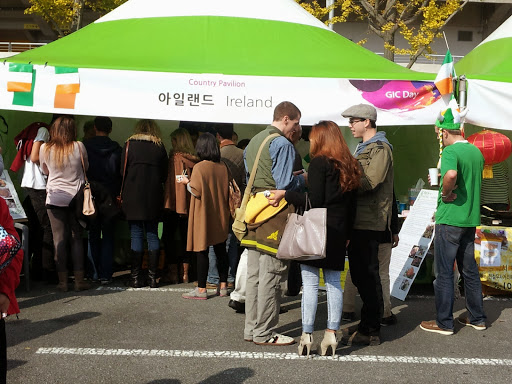
Irish stall, complete with stew and brown bread, at a recent international day
Did O’Connor and his contemporaries understand their Irishness more because it was something which was under threat in their new homes from home? Did every pint of Guinness in a dingy London bar mean more because it was a tenuous connection to Ireland? Possibly. Did every tattered photo of a loved one held in an Irish wallet in New York have extra significance? Perhaps.
Today’s technology, well, you know the drill. Photos flitting across the globe in seconds. You might know more about last night’s party in Galway than the participants do. You’re in your office viewing the pictures as they’re uploaded in real time, while the subjects of the photo might be a tad under the influence.
Where then can today’s Irish emigrants derive a heightened sense of Irishness? There is still something to be said for meeting another Irish person in the middle of nowhere, thousands of miles from home. It’s said that you can link any person to any other person in the world through 6 people. If the two people are Irish, you can probably cut out at least 3 of the links. We’re everywhere and that’s something we get great pride out of. It’s a majorly defining aspect of Irish culture, is emigration. We all know someone from every generation of our families who left the country in search of work and a better life. Some returned, some didn’t.
Maybe emigrants become more aware of how Irish they are when they encounter something that at home they would take for granted. It’s well documented the importance of the GAA in local communities at home, but sometimes it’s easy to dismiss it as just a sports organisation. In Korea it’s hard to describe just how popular it is. People from all corners of the globe come together to play for one of the three clubs in tournaments that run throughout the summer. It’s certainly one of the most popular imported sports in terms of members. When you line out in a Korean soccer stadium with an O’Neill’s jersey on your back, playing gaelic football alongside and against people from every walk of life, it’s hard not to feel an intense surge of pride in your country. And post-tournament, when the drink is flowing and Irish accents are heard all around the bar, that pride only increases.
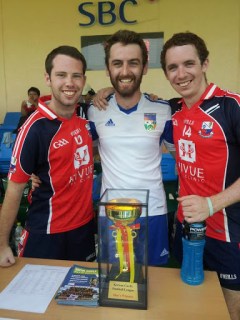
Korean Gaelic Games in Seoul
There is no right or wrong when it comes to emigrating. The people who remain in Ireland deserve recognition for keeping the country going in the face of adversity. Hard work on their part ensures that there’s still a country to come back to for Irish emigrants. However those of us who have left are just fulfilling the quota. It wouldn’t be a proper generation of Irish which didn’t see half its number leave.
This 25th of December, every family in Ireland will think of a loved one far away. Meanwhile on Australian beaches, in London flats and small Korean apartments, Irish people will gather and think of home and everyone in it. Maybe Joseph O’Connor was right and maybe emigrants do feel a heightened sense of Irishness sometimes. Ultimately we’re all from the same tree though. It’s just that some leaves fall farther away than others.
Happy Christmas.
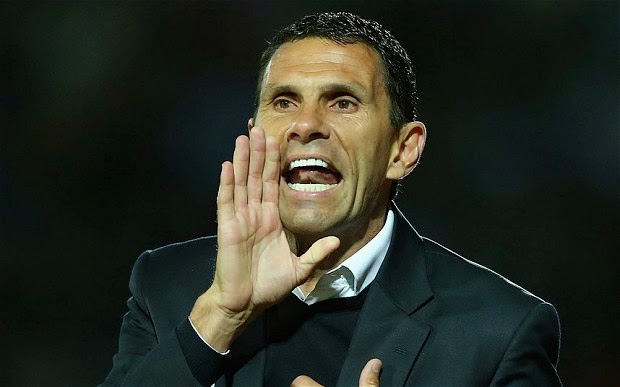
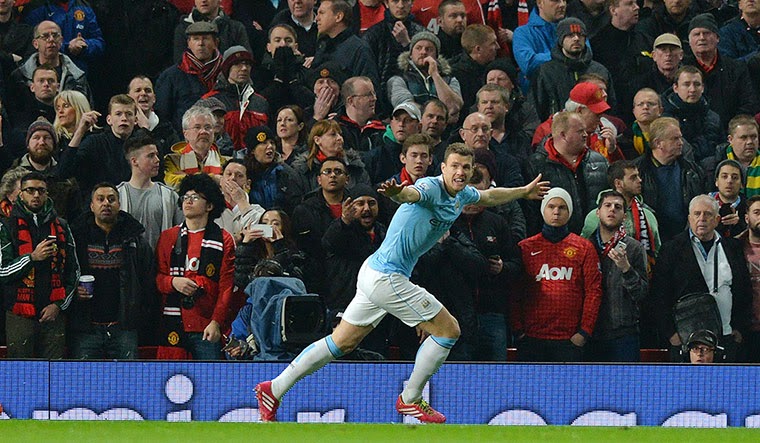
O’Neill and Keane to re-ignite pride in green jersey?

A new era for Irish football
So it’s official, Ireland is under new management. Messrs O’Neill and Keane, appointed to pour petrol on the dying embers left in Giovanni Trappatoni’s wake.
 Martin O’Neill was always going to be in the reckoning following the departure of Giovanni Trappatoni a few weeks back. He has a strong managerial record, is from these shores, and has an infectious passion for the game that could just be the spark needed to breathe life back into the international set-up.
Roy Keane as his assistant, on the other hand, was a bit of a curve ball. Sure, many talking heads mooted the idea of Keane taking up the position of manager if he could just get over his rift with the FAI. However not too many people expected the former midfield general to be content to take a secondary role.
It remains to be seen exactly what role Keane will play in the management team, and whether or not O’Neill will bring in Steve Walford, who was his right-hand man during his tenures at Leicester, Celtic, Aston Villa and Sunderland. If the latter occurs, Walford will almost certainly assume the day-to-day coaching role, with O’Neill and Keane getting involved when it comes to the tactical nuances.
Noel King’s last act (thankfully) as caretaker-manager was to name the squad for the forthcoming Latvia and Poland friendlies. Meaningless up to last weekend, these games have taken on a certain weight as the public awaits the first press conferences of the new regime. There may even be a semi-full Aviva for the Latvia game. While both O’Neill and Keane are charismatic in their own right, it’s probable that the initial media clamour will surround Keane’s first utterances.
And that’s where problems may lie in this partnership. Brian Kerr wrote an interesting article in the Irish Times this week where he spoke about the role of an assistant manager. He noted that a lot of an assistant’s time is spent staring at the manager’s back. Will Keane be content to take a back seat while O’Neill dishes out the words of wisdom before games and at half-time. It’s unlikely, but then perhaps it’s just as improbable that O’Neill hired Keane to sit there quietly.
The old adage that two heads are better than one will hopefully ring true in this arrangement. Can you imagine the amount of Irish players Keane and O’Neill will run the rule over on an average weekend of football across the pond? More than Trappatoni managed in a full year of his tenure probably.
Footballers are human after all. Knowing that your managers have taken the time to come and assess one of your games will surely give any of the Irish players a morale boost. There will presumably be less communication difficulties between management and players given that they’ll all be speaking the same language.
People may question the recent managerial records of both men, with Keane out of football since he left Ipswich in January of 2011, and O’Neill restricted to tv appearances since his sacking from Sunderland in March of this year. Keane has also had some high-profile fallings out with players at the clubs he’s managed (some current Irish internationals included). However both men, and in particular O’Neill, have much to commend them on their CVs.
Keane took Sunderland from relegation danger to Championship winners in his first season, and kept them afloat in the Premier League in his second. O’Neill was mastermind of one of the best spells of success Celtic have had in recent memory, including an appearance in a UEFA Cup final in 2003. He also led Aston Villa to three consecutive top 6 finishes in the Premier League. While it was an above average Villa team he had at the time, it was still no mean feat.
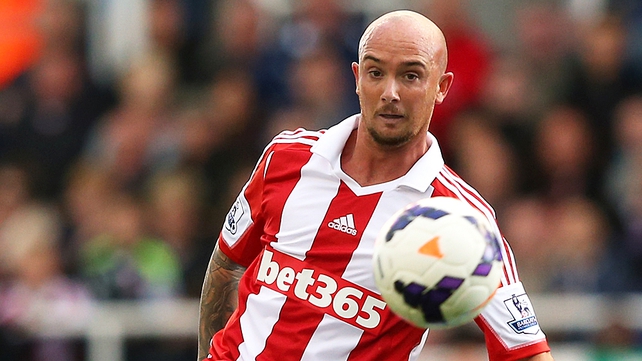
It will be interesting to see the first starting XI named by the new management team, however of much more importance will be the teams named early next year. As mentioned above, Noel King picked this squad. O’Neill and Keane have yet to put their stamp on it. If Keane has his say, for example, could we possibly see a return to the Ireland fold for Stephen Ireland? Keane has spoken about his admiration for his fellow Corkman during Ireland’s international exile, and there have been constant murmurings from the Stoke City midfielder to the tune that he may welcome a return to the green jersey under new management. It shouldn’t be up to a player whether he plays for his international side or not, but if O’Neill and Keane deem his form good enough, Ireland could be a useful addition to the squad.
This managerial partnership has the potential to either end in tears or establish a solid platform for the Irish international side for years to come. Odds have been slashed already on Ireland’s qualification for the next European championships, with the draw for the qualifiers not set to take place until the 23rd of February next year. Whatever happens on the field, Ireland games won’t be dull again for quite a while.
Rep. of Ireland squad for forthcoming friendlies vs Latvia and Poland:
David Forde (Millwall), Keiren Westwood (Sunderland), Rob Elliot (Newcastle), Sean St Ledger (Leicester City), Marc Wilson (Stoke City), Seamus Coleman (Everton), John O’Shea (Sunderland), Alex Pearce (Reading), Stephen Kelly (Reading), Joey O’Brien (West Ham), Ciaran Clark (Aston Villa), Stephen Ward (Brighton & Hove Albion), James McCarthy (Wigan Athletic), Glenn Whelan (Stoke City), Paul Green (Leeds Utd), Andy Reid (Nottingham Forest), Aiden McGeady (Spartak Moscow), Anthony Pilkington (Norwich City), James McClean (Wigan), Robbie Brady (Hull City), Stephen Quinn (Hull City), Wes Hoolahan (Norwich City), Shane Long (West Bromwich Albion), Robbie Keane (LA Galaxy), Jon Walters (Stoke City), Kevin Doyle (Wolves), Anthony Stokes (Celtic).

In From The Cold: King recalls Reid, Gibson and Stokes for October qualifiers

Reid to make his international comeback.

Ireland’s caretaker manager Noel King today announced his provisional 26 man squad for the upcoming qualifiers against Germany and Kazakhstan.

While there are no real changes to the defensive personnel, there is a reshuffle in the centre of the park which sees Darren Gibson return to the fold after a self-imposed exile. Nottingham Forest midfielder Andy Reid gets a call up after being left out in the cold by Trappatoni for the past 5 years. 
Reid is a player of undoubted ability, with a left foot capable of picking the lock of any defence. There have always been question marks over his fitness, however his lack of pace is compensated by his passing, shooting and free-taking ability. Below is a short clip highlighting what he’s capable of. The only pity for Ireland is that Reid, along with Wes Hoolahan, were overlooked by Trappatoni during a period when Ireland were crying out for a creative presence in midfield. Now the two of them are the wrong side of thirty years old, Hoolahan only finding his way into Trappatoni’s plans earlier this year and Reid parachuted in for two World Cup qualifiers rendered almost meaningless by recent results. 
Darron Gibson took himself out of contention for an Ireland call-up following last year’s disappointing European Championship. The decision of Trappatoni not to play him in any of Ireland’s three games was something that rankled, leading him to opt out of playing any more games under the veteran Italian manager. He declared his availability once more when Trappatoni parted ways with the Ireland team and will be a welcome addition to the midfield. 
A return on the cards?
Interestingly, Stephen Ireland is a name that we could be seeing again on the team-sheet. Irish Independent football writer Daniel McDonnell tweeted today “A comeback for Stephen Ireland was discussed. He doesn’t feel in top condition/ready but gave impression he wants to play for Ireland again.” Whether he would be welcomed back by Irish fans is another matter entirely, but there is a precedent for a controversial Corkman returning to the fold.
Up front, Anthony Stokes is called up to the international set-up for the first time since he withdrew from the Carling Cup squad in May 2011. As the only player of the Irish panel currently involved in Champions League football, his inclusion at the expense of Connor Sammon is a welcome one.
Kevin Doyle has also been given a reprieve by Noel King, having missed out on the past few international fixtures. However the Wexford man had not been overlooked by Trappatoni due to some slight, (perceived or otherwise) but rather because of an abysmal run of form. Doyle now plies his trade with Wolverhampton Wanderers in League One and will surely be desperate to get on the field in a green shirt, if only to put himself in the shop window for a January escape. At 30 years old, time is running out for the former Reading striker.
Doyle back in the squad.
Elsewhere in the squad, Richard Dunne and John O’Shea are included despite both being suspended for the Germany game. They will join up with the rest of the team before the Kazakhstan fixture. Darren O’Dea has been omitted from the squad but Noel King is confident he has the strength in depth needed to cope at the back. While Andy Reid returns to the fold, his club-mate Simon Cox misses out.
Provisional 26 man squad:
Forde [Millwall], Westwood [Sunderland], Randolph [Birmingham], O’Brien [West Ham], St Ledger [Leicester], Wilson [Stoke], Coleman [Everton], Kelly [Reading], Clark [Aston Villa], McShane [Hull], Gibson [Everton], Whelan [Stoke], McCarthy [Everton], Green [Leeds], Reid [Nottingham Forest], McGeady [Spartak Moscow], Pilkington [Norwich], McClean [Wigan], Brady [Hull], Quinn [Hull], Hoolahan [Norwich], Long [WBA],Keane [LA Galaxy], Walters [Stoke], Doyle [Wolves], Stokes [Celtic] – O’Shea [Sunderland] and Dunne [QPR] will join squad for Kazakhstan game.