Jury still out on UEFA’s Nations League

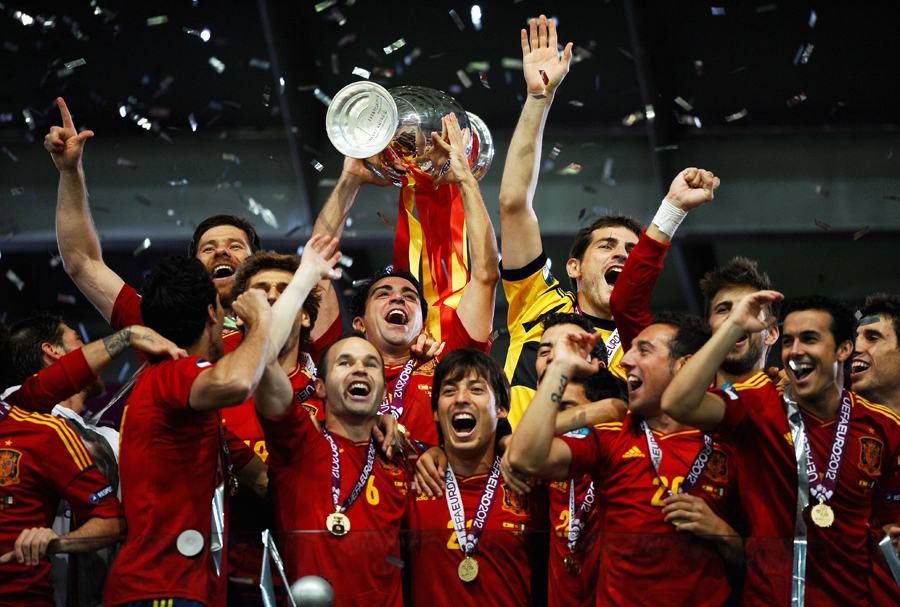
Spain v Italy - UEFA EURO 2012 Final

Spain, winners of a 16 team Euro 2012

In the future, international friendlies will be a thing of the past. The 54 members of UEFA this morning unanimously ratified the proposed Nations League, which will come into effect from 2018 onwards.

The aim of the competition, according to UEFA’s website, will be “to improve the quality and standard of international football.” UEFA admits in its statement that the exact format of the Nations League is yet to be determined, but “the concept is for the 54 teams to be divided into four large groups according to co-efficient rankings.”

When news of this possible development broke earlier in the week, it was easy to dismiss it as a PR move to make international friendlies more appealing. However it has emerged that the Nations League will be linked to the Euro Qualifiers, with extra places in the European Championships at stake.

In some respects this is a welcome move. Weaker countries will get extra opportunities to qualify for the European Championships. Anything that adds some spice to international friendlies can only be good for supporters, particularly Irish ones. If it wasn’t for the appointment of Martin O’Neill and Roy Keane last autumn, the Aviva Stadium would have been harder to fill for games against Latvia and Poland.

However is there really a need to throw another competition into the mix? The Nations League runs the risk of becoming the Europa League of international football; important to the smaller sides but treated with contempt by the top teams. Furthermore, if it is important to the weaker nations, does that allow less room for them to blood new talent? International friendlies, while often tedious, have always been the stepping stone for younger players between club football and the higher intensity of competitive international fixtures. If the Nations League threatens teams with relegation should they lose, will they be reluctant to field inexperienced players?

In any case, with the expansion of the European Championships to 24 teams taking place, surely the current qualification route would have been enough of an opportunity for the weaker teams to stake their claim. Traditionally the group stages of the Euros have been more exciting than those in the World Cup due to fact that there were only 16 teams of a decent quality involved. Raising the quota to 24 teams has already given the third-best side in a qualification group the opportunity to progress to the flagship tournament via the play-offs.

UEFA run the risk of not only diluting the quality of the championship itself but also of the qualifiers. If a team is doing well in the Nations League, will they focus more on achieving their qualifying objective in that manner than in the qualifiers?

These are all questions which cannot be definitively answered until the inaugural Nations League in 2018. The tournament could be a success, or it could be just another ridiculous idea like those linesmen behind the goals who don’t actually do anything.


O’Neill and Keane to re-ignite pride in green jersey?

A new era for Irish football
So it’s official, Ireland is under new management. Messrs O’Neill and Keane, appointed to pour petrol on the dying embers left in Giovanni Trappatoni’s wake.
 Martin O’Neill was always going to be in the reckoning following the departure of Giovanni Trappatoni a few weeks back. He has a strong managerial record, is from these shores, and has an infectious passion for the game that could just be the spark needed to breathe life back into the international set-up.
Roy Keane as his assistant, on the other hand, was a bit of a curve ball. Sure, many talking heads mooted the idea of Keane taking up the position of manager if he could just get over his rift with the FAI. However not too many people expected the former midfield general to be content to take a secondary role.
It remains to be seen exactly what role Keane will play in the management team, and whether or not O’Neill will bring in Steve Walford, who was his right-hand man during his tenures at Leicester, Celtic, Aston Villa and Sunderland. If the latter occurs, Walford will almost certainly assume the day-to-day coaching role, with O’Neill and Keane getting involved when it comes to the tactical nuances.
Noel King’s last act (thankfully) as caretaker-manager was to name the squad for the forthcoming Latvia and Poland friendlies. Meaningless up to last weekend, these games have taken on a certain weight as the public awaits the first press conferences of the new regime. There may even be a semi-full Aviva for the Latvia game. While both O’Neill and Keane are charismatic in their own right, it’s probable that the initial media clamour will surround Keane’s first utterances.
And that’s where problems may lie in this partnership. Brian Kerr wrote an interesting article in the Irish Times this week where he spoke about the role of an assistant manager. He noted that a lot of an assistant’s time is spent staring at the manager’s back. Will Keane be content to take a back seat while O’Neill dishes out the words of wisdom before games and at half-time. It’s unlikely, but then perhaps it’s just as improbable that O’Neill hired Keane to sit there quietly.
The old adage that two heads are better than one will hopefully ring true in this arrangement. Can you imagine the amount of Irish players Keane and O’Neill will run the rule over on an average weekend of football across the pond? More than Trappatoni managed in a full year of his tenure probably.
Footballers are human after all. Knowing that your managers have taken the time to come and assess one of your games will surely give any of the Irish players a morale boost. There will presumably be less communication difficulties between management and players given that they’ll all be speaking the same language.
People may question the recent managerial records of both men, with Keane out of football since he left Ipswich in January of 2011, and O’Neill restricted to tv appearances since his sacking from Sunderland in March of this year. Keane has also had some high-profile fallings out with players at the clubs he’s managed (some current Irish internationals included). However both men, and in particular O’Neill, have much to commend them on their CVs.
Keane took Sunderland from relegation danger to Championship winners in his first season, and kept them afloat in the Premier League in his second. O’Neill was mastermind of one of the best spells of success Celtic have had in recent memory, including an appearance in a UEFA Cup final in 2003. He also led Aston Villa to three consecutive top 6 finishes in the Premier League. While it was an above average Villa team he had at the time, it was still no mean feat.
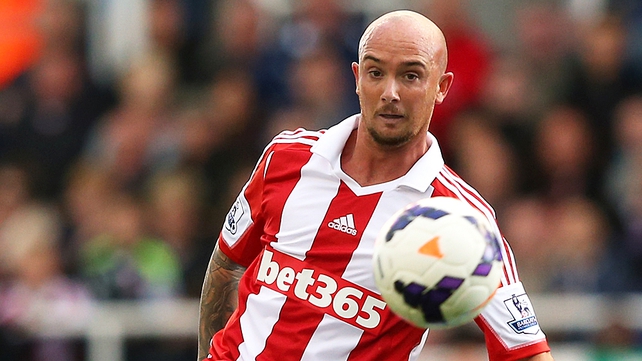
It will be interesting to see the first starting XI named by the new management team, however of much more importance will be the teams named early next year. As mentioned above, Noel King picked this squad. O’Neill and Keane have yet to put their stamp on it. If Keane has his say, for example, could we possibly see a return to the Ireland fold for Stephen Ireland? Keane has spoken about his admiration for his fellow Corkman during Ireland’s international exile, and there have been constant murmurings from the Stoke City midfielder to the tune that he may welcome a return to the green jersey under new management. It shouldn’t be up to a player whether he plays for his international side or not, but if O’Neill and Keane deem his form good enough, Ireland could be a useful addition to the squad.
This managerial partnership has the potential to either end in tears or establish a solid platform for the Irish international side for years to come. Odds have been slashed already on Ireland’s qualification for the next European championships, with the draw for the qualifiers not set to take place until the 23rd of February next year. Whatever happens on the field, Ireland games won’t be dull again for quite a while.
Rep. of Ireland squad for forthcoming friendlies vs Latvia and Poland:
David Forde (Millwall), Keiren Westwood (Sunderland), Rob Elliot (Newcastle), Sean St Ledger (Leicester City), Marc Wilson (Stoke City), Seamus Coleman (Everton), John O’Shea (Sunderland), Alex Pearce (Reading), Stephen Kelly (Reading), Joey O’Brien (West Ham), Ciaran Clark (Aston Villa), Stephen Ward (Brighton & Hove Albion), James McCarthy (Wigan Athletic), Glenn Whelan (Stoke City), Paul Green (Leeds Utd), Andy Reid (Nottingham Forest), Aiden McGeady (Spartak Moscow), Anthony Pilkington (Norwich City), James McClean (Wigan), Robbie Brady (Hull City), Stephen Quinn (Hull City), Wes Hoolahan (Norwich City), Shane Long (West Bromwich Albion), Robbie Keane (LA Galaxy), Jon Walters (Stoke City), Kevin Doyle (Wolves), Anthony Stokes (Celtic).

In From The Cold: King recalls Reid, Gibson and Stokes for October qualifiers

Reid to make his international comeback.

Ireland’s caretaker manager Noel King today announced his provisional 26 man squad for the upcoming qualifiers against Germany and Kazakhstan.

While there are no real changes to the defensive personnel, there is a reshuffle in the centre of the park which sees Darren Gibson return to the fold after a self-imposed exile. Nottingham Forest midfielder Andy Reid gets a call up after being left out in the cold by Trappatoni for the past 5 years. 
Reid is a player of undoubted ability, with a left foot capable of picking the lock of any defence. There have always been question marks over his fitness, however his lack of pace is compensated by his passing, shooting and free-taking ability. Below is a short clip highlighting what he’s capable of. The only pity for Ireland is that Reid, along with Wes Hoolahan, were overlooked by Trappatoni during a period when Ireland were crying out for a creative presence in midfield. Now the two of them are the wrong side of thirty years old, Hoolahan only finding his way into Trappatoni’s plans earlier this year and Reid parachuted in for two World Cup qualifiers rendered almost meaningless by recent results. 
Darron Gibson took himself out of contention for an Ireland call-up following last year’s disappointing European Championship. The decision of Trappatoni not to play him in any of Ireland’s three games was something that rankled, leading him to opt out of playing any more games under the veteran Italian manager. He declared his availability once more when Trappatoni parted ways with the Ireland team and will be a welcome addition to the midfield. 
A return on the cards?
Interestingly, Stephen Ireland is a name that we could be seeing again on the team-sheet. Irish Independent football writer Daniel McDonnell tweeted today “A comeback for Stephen Ireland was discussed. He doesn’t feel in top condition/ready but gave impression he wants to play for Ireland again.” Whether he would be welcomed back by Irish fans is another matter entirely, but there is a precedent for a controversial Corkman returning to the fold.
Up front, Anthony Stokes is called up to the international set-up for the first time since he withdrew from the Carling Cup squad in May 2011. As the only player of the Irish panel currently involved in Champions League football, his inclusion at the expense of Connor Sammon is a welcome one.
Kevin Doyle has also been given a reprieve by Noel King, having missed out on the past few international fixtures. However the Wexford man had not been overlooked by Trappatoni due to some slight, (perceived or otherwise) but rather because of an abysmal run of form. Doyle now plies his trade with Wolverhampton Wanderers in League One and will surely be desperate to get on the field in a green shirt, if only to put himself in the shop window for a January escape. At 30 years old, time is running out for the former Reading striker.
Doyle back in the squad.
Elsewhere in the squad, Richard Dunne and John O’Shea are included despite both being suspended for the Germany game. They will join up with the rest of the team before the Kazakhstan fixture. Darren O’Dea has been omitted from the squad but Noel King is confident he has the strength in depth needed to cope at the back. While Andy Reid returns to the fold, his club-mate Simon Cox misses out.
Provisional 26 man squad:
Forde [Millwall], Westwood [Sunderland], Randolph [Birmingham], O’Brien [West Ham], St Ledger [Leicester], Wilson [Stoke], Coleman [Everton], Kelly [Reading], Clark [Aston Villa], McShane [Hull], Gibson [Everton], Whelan [Stoke], McCarthy [Everton], Green [Leeds], Reid [Nottingham Forest], McGeady [Spartak Moscow], Pilkington [Norwich], McClean [Wigan], Brady [Hull], Quinn [Hull], Hoolahan [Norwich], Long [WBA],Keane [LA Galaxy], Walters [Stoke], Doyle [Wolves], Stokes [Celtic] – O’Shea [Sunderland] and Dunne [QPR] will join squad for Kazakhstan game.

Patriot Games

Get behind them. (Pic:oneteaminireland.blogspot.com)

“I would imagine that the Irish people would be ecstatic if they qualify”. The words of Cindy Blundell, a Toronto native, when asked about the possibility of the Ireland football team reaching a European Championship for the first time in 24 years. Not so Cindy.
                Enthusiasm was scarce around the NUIG campus yesterday when this reporter carried out a survey on how much Ireland qualifying would mean to Irish people. Cindy mentioned that she “would watch it if they got that far”, which was more than could be said for many of the Irish natives questioned. Shane Callinan captured the over all mood perfectly when he said “Its boring for me, I couldn’t give a s**t”
                It has to be asked why this is the case? Why are the Irish people so ambivalent about the possibility of having something to cheer next summer? Surely amidst the unlifting economic gloom, an Irish good news story of this magnitude would be something to warm Irish hearts before what will inevitably be a long winter?
                Perhaps a degree of the apathy is the fault of the Irish team tactics. Whereas the national rugby team in New Zealand played the majority of their games at a hundred miles an hour, watching their football counterparts can sometimes feel like the sporting equivalent of the dentist’s drill. It’s bloody painful.
                That’s no excuse however. The end justifies the means and if Ireland were to attain qualification then any amount of torn out hair and fingernails bitten to the quick would seem a small price to pay.
                Kevin Bourke, a 21 year old from Tipperary, pointed out that “a whole generation of Irish people have never seen Ireland play at a European Championships”. Perhaps then it is a generational gap. It is unlikely that the majority of NUIG students remember the heady days of Jack’s army, and were possibly still too young to appreciate the Saipan incident. Or as it was otherwise called, World Cup 2002.
                Not all those questioned were indifferent however. Some were genuinely excited at the prospect of following Ireland next summer. Conor Nolan, a 41 year old from Athlone said “of course I’m interested, because it’s our country and I’m a patriot”.
                This was an overall theme with those who said they cared about Ireland beating Estonia. It wasn’t so much an affinity with the Irish footballers themselves, but rather the idea that it would be the patriotic thing to do. Paul Curley, 23, from Galway held the opinion that the players were “overpaid and not worth stressing about”, and Samantha O’Connor from Longford merely admitted that “it would be cool to have something to cheer”.
                It really would Samantha. Even Paul Curley’s prediction of “a nil all draw in Tallinn and a scrappy 1-0 win in Dublin” would suffice right now. In terms of Irish support, the tide seems to be out right now, but if Ireland does qualify, then expect the country to be on the crest of a wave next summer.